
Greater China update: A tale of two markets
China Update
For all Asia’s transformations over recent decades, few places have changed as profoundly as Taiwan. When the FSSA team started investing there in the early 1990s, the island had already started to transition from agricultural exports towards electronics manufacturing. But some of the biggest companies in the index were still linked to the older economy – among them Taiwan Pineapple Corporation, a producer of tinned fruit.
Fast-forward to today and Taiwan is the “epicentre of the AI revolution”, as Nvidia’s Jensen Huang has put it.1 Its leading business is Taiwan Semiconductor Manufacturing (TSMC), the chipmaker responsible for the vast majority of the advanced semiconductors that power data centres around the world. Taiwan now has a complete semiconductor and hardware manufacturing ecosystem to support global AI investment.
Over the last 12 months, FSSA’s Greater China strategy has benefited from the robust performance of TSMC and other Taiwan-based technology holdings, as the boom in capital expenditure on AI infrastructure has led to surging demand and strong profit growth among these businesses.
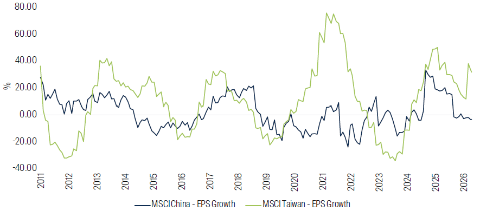
Across the Taiwan Strait, however, the picture is rather different. Our China investments have delivered mostly underwhelming returns. Although the country’s technology hardware sector is doing well, earnings in other areas have been affected by stagnant consumer spending and the phenomenon of neijuan, or “involution”, a cycle of grinding competition and cost-cutting.
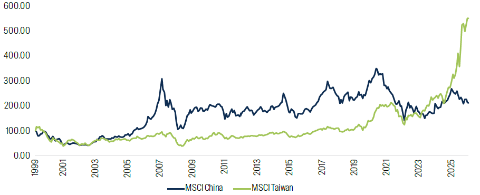
This growth differential has led to a sharp divergence in performance between the two markets, as Figures 1 and 2 illustrate. We appreciate Taiwan tech companies’ world-leading franchises and strong growth; at the same time, we continue to find opportunities in China, where we believe high-quality, cash-generative businesses with talented leadership teams are being overlooked.
Figure 1. MSCI China vs MSCI Taiwan, price index in USD (rebased to 2000)
Source: FactSet, MSCI, October 15, 2026.
Figure 2. MSCI China vs MSCI Taiwan, earnings per share (EPS) growth
Source: FactSet, MSCI, October 15, 2026.
Booms and cycles
The pace of Taiwan’s growth over the last 12 months has been extraordinary. Its market now has a bigger weighting in the major regional indices than China, even though China’s economy is 20 times larger and considerably more diverse. Taiwan’s share of the MSCI AC Asia-Pacific ex Japan Index increased from 19% at end-September 2025 to 29% at the same point in 2026, while China’s fell from 30% to 20%.2
Although the current disparity in performance between Taiwan and China is striking, their relative standing has shifted repeatedly over the years. For example, in 2001, when Taiwan’s tech sector was struggling to recover from the bursting of the dot-com bubble, China was granted entry into the World Trade Organisation (WTO). This accelerated its integration into the world economy and boosted its growth prospects. Investor returns in China surged in the 2000s, before falling sharply in the wake of the Global Financial Crisis.
Meanwhile, Taiwan struggled to excite investors. The maturing of the personal computer (PC) industry after the early 2010s weighed on growth expectations for Taiwan-based suppliers, and depressed share prices meant high-quality Taiwanese companies could be purchased at dividend yields of around 5%. China, by contrast, benefited from rapid economic development throughout the decade, contributing to stronger market performance and much richer valuations.
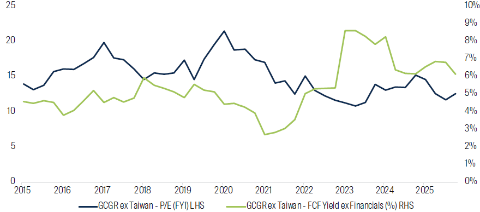
Another reversal began in 2021, as Beijing’s regulatory crackdown on large internet companies, the collapse of the property sector and a broader decline in consumer confidence weighed on China equities. The divergence has accelerated since 2025, as Taiwan’s position in the AI supply chain has driven a historic rally. Rather than being valued on income metrics such as dividend yield, leading Taiwanese companies are now routinely assessed on growth-adjusted measures such as price/earnings-to-growth (PEG). China, while not quite at the low-growth, valued-on-dividend stage Taiwan reached in the 2010s, looks to us to be underappreciated, with our holdings trading at a 6% free cash flow yield (see Figure 3).3
History suggests that current market conditions are unlikely to continue indefinitely. Rather than trying to predict the next shift in market leadership, however, we maintain our bottom-up focus on individual companies and the qualities that help them compound over time, such as innovation, adaptability and strong leadership. In this letter, we will consider how these themes are reflected in our holdings across both markets, before examining the drivers of recent performance.
Figure 3. China holdings: 12-month forward price-to-earnings (P/E) (LHS) and free cash flow (FCF) yield (RHS)
Note: China holdings of the Greater China Growth strategy. FCF yield shown ex-financials. Source: FSSA Investment Managers, FactSet, as at September 30, 2026.
The innovation race
Taiwan’s development over recent decades demonstrates how an industrial ecosystem can evolve through successive waves of technological change. Having established themselves in PC outsourcing, Taiwanese companies are now playing a leading role in the infrastructure required for AI.
Taiwan has developed capabilities across much of the technology hardware value chain, encompassing chip design and advanced packaging, server assembly, printed circuit boards (PCBs) and specialist materials, as well as the power-management, cooling and interconnect technologies required for increasingly complex data centres. Several of our holdings occupy important positions within this network, as we discuss below.
Although Taiwan currently possesses the more complete AI hardware ecosystem, innovation across Greater China is not confined to one side of the Strait. Both the state and the private sector in China are investing heavily to build domestic semiconductor capabilities and hardware supply chains, and we are actively monitoring developments in this space.
It is worth remembering that China has repeatedly demonstrated an ability to close technology gaps in the past. For example, during the smartphone boom of the 2010s, Chinese companies rapidly built engineering knowledge and began winning market share from Taiwanese leaders.
Our holding Luxshare Precision is a case in point: co-founder and CEO Wang Laichun started her career as an assembly-line worker at Taiwan’s Hon Hai Precision Industry, before launching Luxshare in 2004. A decade on, her company was outcompeting Taiwanese peers for major assembly contracts, such as for Apple’s iPhone, AirPods and Apple Watch. Luxshare has taken steps to diversify its business – AI data-centre components such as interconnects, optical parts, power supplies and cooling systems are expected to contribute a growing portion of its revenue.
Another Chinese technology holding with a presence in the AI value chain is SG Micro, a Beijing-based integrated circuit (IC) analogue chip designer. Founded in 2007, the company has steadily upgraded and broadened its portfolio across signal chain and power-management products. The company has recently benefited from demand for chips used in the optical transceiver modules that connect data centres to fibre-optic networks. When we met founder and chairman Zhang Shilong in Beijing in May, we were encouraged by his long-term ambition to build “the Texas Instruments of China”, while pursuing growth sustainably and developing in-house engineering talent.
Luxshare and SG Micro launched secondary listings in Hong Kong in 2026 and we subscribed to both (we were already holders of the former’s A-shares). Enthusiasm for AI-related stocks was evident in strong initial demand for the listings, but subsequent weakness has enabled us to build larger positions in the two companies at reasonable valuations.
Resilience through downcycles
Every business has a cycle. Companies need to be able to adapt and, if necessary, reinvent themselves during more challenging periods. We have seen this pattern across both markets in the past.
In Taiwan, we have longstanding relationships with many of our holdings and have witnessed close-up how they have fared under difficult conditions. Chip designer MediaTek, which we have owned in the Greater China portfolios for over a decade, is a good example.
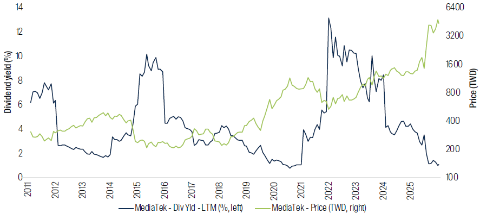
Under the leadership of Rick Tsai (formerly of TSMC), who took over as CEO in 2017, MediaTek has modified its approach – it has redesigned its cost structure, built closer relationships with customers and diversified its business beyond consumer products. Our conviction in the company’s strategy meant we remained invested through tough periods such as 2022-23, when the share price fell against a backdrop of weakness in global spending on smartphones (see Figure 4).
Market perceptions have changed dramatically since then, amid rising optimism around MediaTek’s AI application-specific integrated circuit (ASIC) business, which is expected to begin contributing from the fourth quarter of 2026. While we remain confident in the company’s long-term prospects – its core smartphone business should allow it to benefit as AI features are embedded in consumer devices – we see AI excitement as increasingly reflected in the company’s valuation and have therefore been trimming our stake to control the position size.
Figure 4. MediaTek share price and dividend yield, 2011-2026
Source: FactSet, October 15, 2026. LTM = last twelve months.
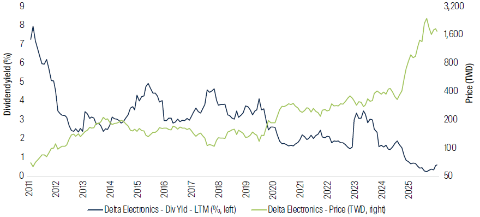
Another example of a company that has smartly repositioned itself is power-management specialist Delta Electronics. We have known the company for years and appreciate its commitment to research and development (R&D). However, Delta struggled with growth in the late 2010s due to the maturing of the PC market and a lack of technology migration in power electronics.
In retrospect, Delta was laying the groundwork for the next phase. We reinitiated a position in 2023 as its investments in power management showed signs of bearing fruit, and we have since witnessed the company’s shares re-rate as it has cemented its leadership in AI server power (see Figure 5).
Our recent meetings with Delta indicate that, far from resting on its laurels, the company is again looking ahead for ways to maintain its competitive advantage. For example, it is seeking to build its presence in data-centre power infrastructure beyond servers, including power distribution and emerging on-site energy solutions.
Figure 5. Delta Electronics share price and dividend yield, 2011-2026
Source: FactSet, October 15, 2026.
How Chinese companies are adapting to change
The same test of adaptability is currently playing out in China, albeit against a different backdrop of soft demand and intense competition. We have seen our China holdings respond to a challenging environment in different ways. Medical-device manufacturer Shenzhen Mindray is developing recurring revenue streams through its growing in-vitro diagnostics business; testing and verification provider Centre Testing is diversifying its customer base and entering new segments; and battery maker Contemporary Amperex Technology (CATL) is expanding from electric-vehicle batteries into broader energy-storage solutions.
This adaptability is also evident among our holdings in consumer franchises, several of which have been making efforts to strengthen their competitive positions despite weak consumer spending. For example, H World has evolved from a traditional hotel operator, which owned properties directly, into a more asset-light business based on managed and franchised (“manachised”) hotels. This has reduced its capital intensity. At the same time, the company has expanded beyond low-cost accommodation into a broader portfolio of brands – such as the midscale Ji Hotel platform – while continuing to build a loyalty programme that now totals more than 300 million members.
These changes have helped H World reinforce its standing even in a sluggish consumer environment. In China’s fragmented hotel market, independent operators facing reduced custom are often more willing to join established brands; H World is increasingly targeting conversions of existing hotels. Meanwhile, the company’s large membership base and direct-booking channels reduce its reliance on third-party travel agencies. We believe these structural advantages should allow H World to continue gaining share over time.
Another example is Kweichow Moutai, China’s leading premium baijiu producer. We added it to the portfolio in late 2025 when an industry downturn opened what we saw as an attractive entry point. Demand for high-end spirits has been affected by weak consumption and periodic government restrictions on banqueting and gift-giving, and Moutai’s shares have fallen as part of the broader industry downcycle since 2021.
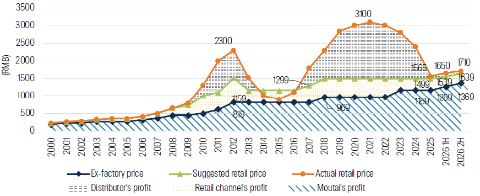
We believe the market underestimates the brand’s enduring appeal and have been encouraged by recent strategic adjustments. Under CEO Wang Li, the company has changed its pricing and distribution structures, including raising the ex-factory price of flagship Feitian Moutai, with the aim of capturing more of the profits previously retained by distributors (see Figure 6).
While alignment is not perfect, given the Guizhou government’s controlling interest and management’s limited ownership, capital allocation has become more shareholder friendly: including dividends and buybacks, Moutai returned almost 80% of its 2025 net profit to shareholders.4 Alongside the strength of its brand and long track record of compounding returns, these positive developments support what we consider to be a solid long-term investment case.
Figure 6. Kweichow Moutai pricing and profit distribution
Source: FSSA Investment Managers, company disclosures, August 2026.
Performance and positioning: What helped…
Together, these examples illustrate the qualities we seek in companies across both markets, such as the capacity to invest through difficult periods, strengthen competitive positions and emerge with better long-term prospects.
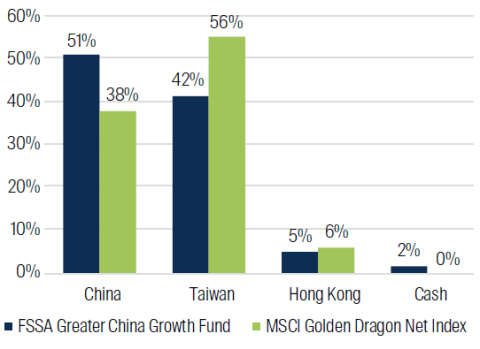
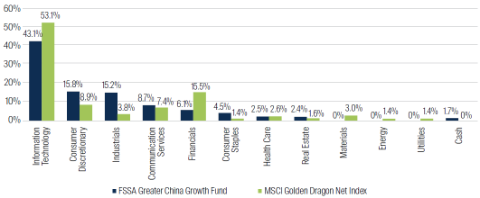
The strategy remains diversified across markets and sectors, reflecting our bottom-up approach and focus on individual companies rather than top-down allocations (see Figure 7). Within Taiwan’s technology industry, where valuations and growth expectations have risen, company selection remains especially important. We favour businesses whose expansion is supported by technological leadership, rising content per system or market-share gains, as these characteristics should provide a stronger foundation for long-term value creation than growth driven primarily by temporary supply constraints or pricing.
Figure 7. Greater China Growth: portfolio breakdown by market and sector vs the index
Source: FSSA Investment Managers, as at September 30, 2026.
Given its central position in the AI supply chain, it is not surprising that TSMC was the biggest positive contributor to performance over the last 12 months.5 TSMC has a 70% share in the global foundry industry and dominates manufacturing at five nanometres or smaller, the cutting-edge technologies required for frontier AI chips. In its most advanced processes, TSMC can etch circuitry onto silicon wafers with features that are only a few times wider than a strand of human DNA.
This technological lead enables TSMC to command premium pricing at the most advanced nodes, while the resulting cash flows support its substantial investment in future production capacity. Its approach remains disciplined, however: as Figure 8 illustrates, TSMC moderated capital expenditure during the early stages of the AI boom in 2023 and 2024, before increasing it as demand became more concrete. This combination of technical leadership and disciplined capital allocation is a key reason why it remains the strategy’s largest holding.
Figure 8. TSMC’s disciplined capital expenditure ($bn)
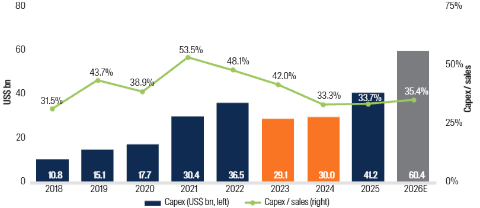
Source: TSMC annual filings and company guidance, FactSet, FSSA Investment Managers, October 15, 2026. 2026 figure is an estimate.
Other major contributors were Taiwan-based companies benefiting from the growth of AI infrastructure, including MediaTek and Delta, along with Lite-On Technology, which is seeing strong data-centre demand for its power-supply equipment.
The strategy has also benefited from exposure to other “picks and shovels” of the AI era, such as PCBs, which provide the circuitry that connects the chips powering advanced AI servers. Our holdings in this area include PCB manufacturer Tripod Technology. Further upstream in the supply chain, we own Elite Material, a supplier of copper-clad laminates (CCL), a key material used in PCB production; the company has around 70% market share in high-density interconnects (HDI), a technology being adopted for use in data-centre servers.
The scale of investment by US hyperscalers such as Microsoft, Amazon, Alphabet and Meta provides a strong demand backdrop for these businesses. At the same time, we are monitoring the ways in which this growth is distributed across the supply chain and how companies are responding by setting prices and adding capacity.
…and what hurt
The benefits of AI-related exposure were offset in part by weakness among several China holdings. The principal detractors were affected either by concerns about AI disruption or pressure from subdued consumption and competition. In each case, our focus has been on whether these developments substantively alter the company’s long-term positioning.
Tencent, for example, has fallen amid investor concerns it is being left behind in the AI race. However, our meetings with management throughout this period have reassured us as to its long-term strategy. While it was arguably slow to ramp up investment in a proprietary state-of-the-art large language model (LLM), its Hunyuan AI model has recently shown encouraging progress and is being integrated into its various applications. More importantly, Tencent’s vast digital product ecosystem is providing opportunities to monetise AI in areas such as advertising targeting and games development.
Beyond technology, the reluctance of citizens to open their wallets has weighed on several of our consumer-related holdings. One consequence of this sluggish demand has been fierce competition for business, with food delivery emerging as a key involution battleground.
For example, local-services platform Meituan incurred losses after it was compelled to offer subsidies to defend its leading position from JD.com and Alibaba, which aggressively entered the food-delivery market in 2025. At the same time, it faced increasing competition from ByteDance in its in-store business. We backed Meituan’s efforts to defend its position, while questioning JD.com’s entry into food delivery, which seemed an awkward fit with its core operations. (This contributed to our decision to sell JD.com last year.) In our view, the competition was affecting Meituan’s near-term profitability, rather than permanently impairing its franchise.
Since the start of 2026, Alibaba and ByteDance have shifted the focus of their investment towards cloud computing and AI, while the government has issued new draft rules on food-delivery subsidies as part of a wider effort to tackle involution across the economy. The easing of competitive intensity should benefit Meituan: its food-delivery business has returned to profitability, and the company is now eyeing overseas opportunities and new growth initiatives in grocery retail. We have consequently been adding to the position.
Conclusion and outlook
As ever, Taiwan and China present their own particular balance of opportunities and risks. Taiwan is home to exceptional businesses benefiting from powerful structural growth in AI infrastructure, and we believe their technological leadership and capacity for innovation should support attractive long-term opportunities. We are sticking with companies that benefit from technological upgrades and those with the potential to gain market share.
China’s economic outlook is more uncertain, but weak sentiment and lower expectations have led to opportunities across a broader range of industries, and we believe the positive changes occurring among our China investments are bearing fruit. In aggregate, the China holdings in the portfolio currently generate a free cash flow yield of 6%, compared with around 3% for MSCI China, despite offering similar prospects for earnings growth over the next two years.6 Our China holdings also exhibit higher returns on equity and stronger balance sheets than the average across the broader index, suggesting the market is underappreciating both their cash-generation potential and underlying quality.7
While we are optimistic about the longer-term future for both markets, we do not seek to predict the next shift in leadership. Instead, we remain focused on identifying reasonably valued companies with capable leaders, attractive growth prospects and resilient balance sheets – wherever they are listed in Greater China.
We thank you for your continued support.
References
Source: All company data herein retrieved from company annual reports or other such investor reports. Financial metrics and valuations are from FactSet and Bloomberg. As at September 30, 2026 or otherwise noted.
1 “Nvidia to spend $150 billion a year in Taiwan, 'epicentre' of AI revolution, says CEO”, Reuters, May 27, 2026. AI = artificial intelligence.
2 MSCI, FactSet, as of September 30, 2026.
3 FCF yield = ex-financials. FSSA, FactSet as of September 30, 2026.
4 Source: Kweichow Moutai 2025 annual report.
5 Performance review covers the 12 months to September 30, 2026. Past performance is not a guide to future performance.
6 FCF yield = ex-financials. FSSA, FactSet as of September 30, 2026.
7 Based on 17.8% return on equity and -1.4x net debt to earnings (ex-financials) for the China holdings in the Greater China Growth strategy, vs. 14.5% return on equity and -0.6x net debt to earnings (ex-financials) for the MSCI China. FSSA, FactSet as of September 30, 2026. Past performance is not a guide to future performance.
Read our latest insights

- Article
- 6 mins

- Article
- 8 mins

- Article
- 12 mins