The longest race
This July two great spectacles ended within days of each other. The first was the world’s most famous cycling race, the Tour de France. On its final day in Paris, Slovenian Tadej Pogačar rode up the Champs-Élysées in the winner's yellow jersey for the fifth time, joining a club to which a century of racing had previously admitted only four riders.
The second played out in Seoul, where the sharpest equity boom in the recent history of a major market met its correction: an index that had risen nearly threefold in fourteen months fell by roughly a third in five weeks; more than a million leveraged accounts received margin calls; and a government minister apologised for the damage done by financial products his regulator had approved in the spring.
The FSSA Global Emerging Markets Focus portfolio owns the two companies at the centre of the second spectacle. Samsung Electronics and SK Hynix sit at the heart of the Korean market, together comprising roughly half its value. When we wrote about these holdings earlier in the year – specifically, the engineering challenges underlying the high-stakes contest to secure allocations to supply high bandwidth memory for Nvidia’s next generation of graphics processing units – we declared two things. First, that the competitive contest between them is study material of rare quality; and second, that we had been reducing our positions against an enthusiasm we could not underwrite.
Both statements have aged tolerably, though we take no satisfaction in the second. We claim no ability in having timed the turn, but we took the opportunity to add back modestly to our holdings at newly attractive entry points. We manage diversified portfolios, which give us room to do so; if we were fully loaded in one sector, or had leveraged, we too would have been forced to unwind. But our reason for revisiting the topic again so soon is that July offered a broader lesson in the structure of modern markets. Our previous piece used the football World Cup as a frame. The Tour de France – or simply “the Tour” – started less than a month later, to which we hope you'll permit one further sporting analogy as we think the parallels are instructive.
One road, many races
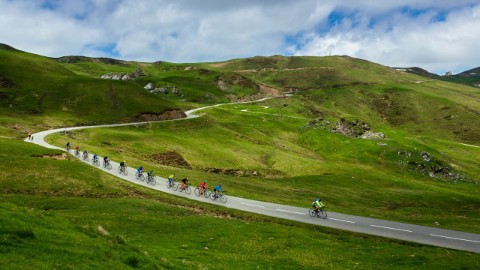
To the uninitiated, the Tour looks deceptively like a single contest: close to two hundred riders, twenty-one stages crossing five mountain ranges, first to Paris wins. But in reality, it is several competitions running simultaneously, with distinctive coloured jerseys the prize for each. Sprinters race for green at intermediate lines mid-stage and care little about what happens in the mountains. Climbers race for the polka dots on the summits and surrender time everywhere else. Young riders race only each other for white. Opportunists hunt single-stage wins. And a small number of riders, with strong teams around them, ride for the general classification, the yellow jersey, awarded for the lowest cumulative time over three full weeks. Everyone shares the road. But far fewer share a goal.
We believe markets too may be better understood as an ecosystem rather than a single crowd. Participants operate with different incentives, constraints, mandates and time horizons. Multi-manager hedge funds run tight risk limits and become forced sellers when positions move against them. Options traders deal in contracts that expire the same afternoon and generate flows with no view beyond the close. Momentum-based algorithms accelerate what is already moving. Index funds buy whatever the rulebook says, at the market price and in whatever size the inflows dictate. Retail investors, increasingly organised into online communities, ride enthusiasm in packs. And somewhere in the bunch are the fundamental investors, riding for the general classification: cumulative business value, compounded over years.
When a share price moves violently, the instinct is to ask what the market knows. But perhaps the better question is: which race just passed through? Most days, price movements are generated by riders in competitions we have not entered. This is especially true in Korea, where in recent years an estimated two thirds of domestic equity trading volumes have been driven by retail participants.1 Other markets in north Asia (China A-Share, Taiwan) are also dominated by retail investors, but for the most part – like in India, Japan, the US and in Europe – the number is far lower. So, ignoring the investor group in Korea that self-describes as “ants” is easier said than done. Sustaining our own race through their surges takes a team, as it does in the Tour.
Drafting
A group of riders travelling together in a cycling race is called a “peloton”, and the physics of the group explains even more about modern markets than the jerseys do. A rider tucked into the bunch benefits from slipstream aerodynamics and expends roughly a third less energy than one riding alone. That is why the pack exists. But “drafting”, as the technique is called, has a corollary: the riders at the centre of the peloton are not setting the pace – it is being determined by the handful at the front.
In Korea this spring, many of those at the front of the peloton were retail investors riding two-times-leveraged, single-stock exchange-traded funds launched only weeks earlier. By June those products and their relatives had grown to nearly a third of the assets in Korea-focused funds,2 and two companies, SK Hynix and Samsung Electronics, were dragging an entire national market up the mountain.
Meanwhile, markets have spent two decades reorganising themselves around the draft. With the rise of passive investment vehicles, the mechanical is becoming the majority – and it takes whatever speed the road offers. The result is a market in which an ever-larger group is pulled into the draft, and an ever-more-excitable group of retail investors dictates the tempo of the bunch.
The crash
Cycling has a phrase for how disasters begin: a touch of wheels. One rider clips another and fifty go down, most of whom had done nothing wrong – except to ride close together at speed. Leverage recreates this in markets. The daily rebalancing of a leveraged fund contractually obliges it to buy into every rise and sell into every fall; it is the same as a rider who must accelerate into every sprint and brake into every deceleration, with just an inch between himself and the wheel in front.
In July the wheels touched. A brokerage downgraded its memory-chip outlook, the central bank raised rates and the regulator tightened terms. A pile-up followed. The KOSPI fell by roughly a third from its June peak and the largest leveraged fund tracking SK Hynix lost more than 80% of its value over the same period.3 By mid-July more than 1.2 million leveraged accounts had hit margin-call thresholds, and many investors had their accounts forcibly closed.4 Meanwhile, SK Hynix itself reported record profits. The shocking speed with which leverage can eliminate accumulated gains reminded us why we have always treated leverage as kryptonite for compounding. The Tour has a vehicle called the “broom wagon” that follows the race to collect riders who cannot continue. It was unfortunately busy in recent weeks.
The team car and the sponsor
For active managers like us, it would be easy to conclude that all of this is simply noise around an unchanging signal, that prices rage while fundamentals proceed serenely underneath. In cycling, the yellow jersey attracts the sponsor which funds the budget, and this pays domestiques (support riders) to help defend the next yellow jersey. Success buys the means to future success. Markets have the same loop: a high share price equates directly to a lower cost of equity capital and can be a real competitive weapon. Tesla remains a canonical case. In 2020 its shares rose roughly sevenfold and the company raised approximately US$12 billion of new equity into that fervour – nearly free money for real factories.5 In December of that year, the S&P DJI’s Index Committee admitted it to the S&P 500, whereupon every tracking fund on earth became a compelled buyer at whatever price had been set in the excitement. SpaceX repeated the pattern at even greater scale in June 2026, with Nasdaq and FTSE Russell rewriting their entry rules to allow its inclusion within days of it listing.6 It can feel at times that the marginal price of equity is now set on message boards, while the mechanical majority simply pays it. This may be an exaggeration, but the shifting forces underlying market prices are real.
This is why we resist the purist's sneer at animal spirits. Sentiment is not merely weather over the racecourse; within limits, it feeds the riders. A memory maker whose shares are adored can fund its fabs on advantageous terms precisely when the capital expenditure (capex) race is fiercest. The voting machine, to borrow Benjamin Graham's famous image, does more than misprice the weighing machine's verdict in the short run; occasionally, it loads the scales. An honest fundamental investor holds both thoughts at once: prices eventually obey business value, but business value is not deaf to prices.
Riding for the general classification
However, the operative word is “eventually”, and our craft lives in the gap between short term and long term. Long-term cash flow is the closest thing investing has to Newtonian law. Sentiment can hide it from view for long stretches, but it cannot repeal it. Graham's machines still run in their proper order: the votes are counted daily, but a company’s intrinsic value is properly weighed over years. And none of this is new under the sun. Charles Mackay catalogued popular delusions and the madness of crowds in 1841; the Korean spring of 2026 would have slotted into his chapters without editing.
What is genuinely new is the amplitude. A peloton in which the drafting mass has doubled, and the front is ridden on leverage, moves faster in both directions than the one the textbooks describe; the same road now produces bigger gaps and harder crashes. If we could choose, we’d rather not have to tolerate this heightened volatility. But it is a toll that the modern course charges to stay in the race, and we budget for it in position sizes that let us stay upright when others’ wheels touch. This year's Tour made the point brutally. Jonas Vingegaard, twice a champion, crashed out on a busy bend; and Torstein Træen, in yellow, just days earlier fell on a descent. Neither lost the race through weakness. They lost it through proximity to other people's risk, which, again, is why we prefer to avoid leverage both at the portfolio level, and on the balance sheets of companies we own (the current portfolio holds net cash). Survival precedes compounding; the first requirement for winning in Paris is arriving there.
There is one more requirement, and it is the least visible on television. Nobody wins the general classification alone. The rider in yellow is sheltered for three weeks by teammates who surrender their own chances, fetch bottles, close gaps and take the wind, so that one rider can spend his strength where the race will be decided. An investment manager's team, in this sense, is its clients. A long horizon is not something we own or take for granted; it is something you extend to us, and it is renewed every time volatility invites a change of race and you decline the invitation on our behalf. The recent period has drawn on that patience more than most. Not just in the volatility of these past weeks, but more so over the year that preceded them, in which returns were concentrated around a narrow group of favourites, and a portfolio built like ours endured stretches of underperformance as the road tilted toward races we have chosen not to ride. We are conscious of it, and of the simple truth that our positioning can only ever be as long term as the support that stands behind it.
Within the race, we ride like the man aiming for the yellow. In the final mountain stage, Pogačar, yellow secure, let Richard Carapaz ride away for the polka-dot jersey without a flicker of pursuit. He knew which competition he had entered, and, just as importantly, which ones he had not. As do we. The sprints for the leveraged, the summits for the momentum riders, the daily lines for the algorithms; those jerseys are all genuinely contested by capable people, and we are happy to stand aside.
Paris
Like the Tour, long-term investment outcomes are not determined by any intermediate sprint. Avoidance of ruin should be a participant’s first priority (and is ours). Our holdings in Samsung Electronics, SK Hynix and TSMC continue to express deeply underwritten fundamental views, at weightings that reflect our humility about risk. The bunch will surge and crash; the broom wagon will fill again. We intend to be neither in the front when the wheels touch nor in the wagon afterwards, but where general-classification riders belong, pursuing the yellow jersey and riding the long race to Paris.
Footnotes
1 Estimates calculated by FSSA Investment Managers, based on Korea Exchange (KRX) and Nextrade data, as at August 2026.
3 https://www.cnbc.com/2026/07/29/korea-leveraged-etf-kodex-sk-hynix.html
4 https://www.odaily.news/en/newsflash/501549
5 Source: Company reports, FactSet, retrieved August 2026.
6 https://global.morningstar.com/en-gb/stocks/spacex-ipo-how-indexes-will-adapt
Read our latest insights

- Article
- 3 mins

- Article
- 5 mins

- Article
- 10 mins